
By Pirjo Merilahti, Ph.D., Technology Manager, Gene Therapy Manufacturing & Development at 3PBIOVIAN
Gene therapy programs are advancing rapidly from early development into late clinical phases and commercialization. For gene therapy specialists, this transition brings a familiar—but often underestimated—challenge: scaling viral vector manufacturing processes while preserving product quality, process robustness, and regulatory compliance, all while meeting increasing material demands and tight timelines.
Having supported gene therapy programs across multiple development stages, we consistently see this transition as one of the most critical inflection points in program progression. Many of the factors that ultimately determine whether a process can scale successfully are set well before manufacturing begins. Decisions made early around process design, modelling strategies, and execution assumptions often have lasting implications as programs move toward larger-scale production.
Across the industry, early development is not always planned with large-scale execution in mind, which is why scale-up challenges frequently emerge later than they should. At 3PBIOVIAN, our approach is built around identifying these risks much earlier—embedding scalability, robustness, and regulatory readiness into development decisions from the outset to reduce downstream risk and avoid costly rework.
Upscaling viral vector production: more than increasing volume
Upscaling viral vector production is fundamentally different from scaling recombinant proteins or traditional biologics. Adenovirus and AAV processes are highly sensitive to cell physiology, infection timing, and downstream handling. Across both adenovirus and AAV
programs we support, we consistently observe that decisions made at small scale — around culture mode, infection strategy, and harvest conditions — have a disproportionate impact on large-scale performance.
Common scale-up challenges include:
- Maintaining productivity and consistency at increasing scale
- Managing the transition between adherent and suspension systems
- Ensuring processes meet future GMP expectations
- Generating data that supports comparability across scales and between GMP batches
These challenges highlight that scale-up is not solely an operational milestone. It is closely tied to how processes are initially designed, evaluated, and executed. Addressing them effectively depends on data-driven decision making, thoughtful process design, and an understanding of how early models translate into future manufacturing conditions.
In practical terms, downscale models must reflect large-scale reality. In our development programs, models are intentionally designed to incorporate extended seed trains, defined hold times, and aseptic handling outside laminar airflow — factors that often become limiting only once processes are transferred into GMP environments.
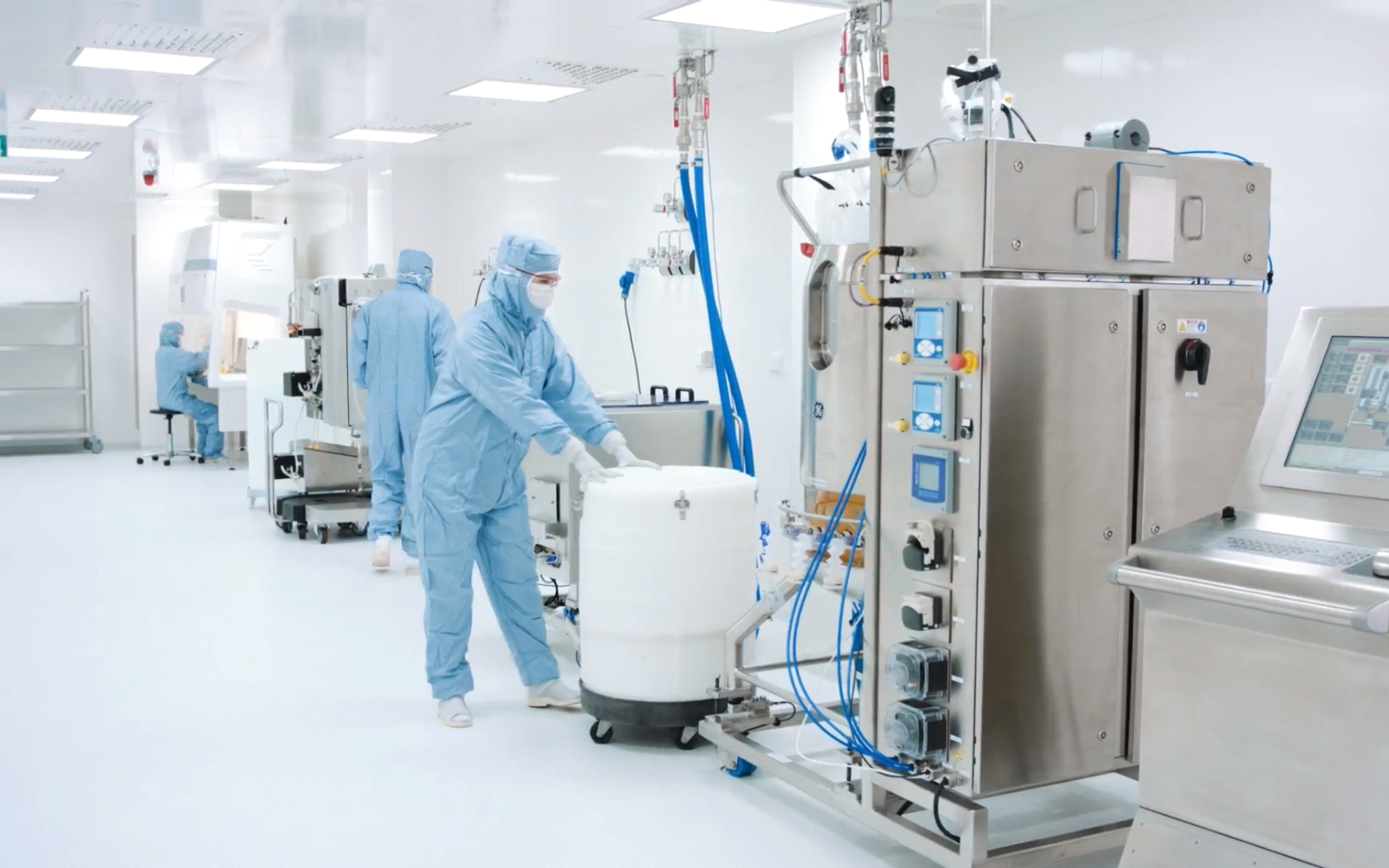
At larger scales, both adherent and suspension processes undergo a fundamental shift in execution. Seed trains expand, timelines lengthen, and operations move into classified cleanroom environments using closed or functionally closed systems. In many cases, seed train expansion itself requires bioreactor cultivation, introducing additional process control and scheduling demands upstream of production.
Careful coordination of materials, equipment, facilities, and trained personnel becomes essential. By integrating these execution constraints early — starting at mid-scale — processes are more likely to translate into large-scale manufacturing with consistency,
reproducibility, and GMP compliance. Designing small-scale models around these realities helps ensure that development data remain predictive for GMP execution.
One of the key strengths of an experienced gene therapy CDMO is the ability to support multiple upscaling pathways, rather than forcing a one-size-fits-all solution.
Adherent scale-up: early considerations for future manufacturability
For adenovirus programs based on adherent cell lines, successful scale-up is not only a biological challenge but also one of practical manufacturability. In adherent adenovirus programs we have supported, scale-up success has repeatedly depended on anticipating how the process will actually be executed at large scale — not just how it performs biologically at small scale.
Early development is often performed in environments that allow full handling within laminar airflow hoods, with seed trains expanded in small flasks and manipulations performed under direct aseptic protection. Transitioning from this environment into large fixed-bed bioreactors represents a fundamental shift in execution.
Key considerations that can be evaluated early include:
- Replication of cell density and infection conditions across scales, ensuring that the biological state of the culture at infection remains comparable between development and GMP manufacturing, despite major increases in volume and surface area
- Use of metabolic KPIs, such as glucose consumption and lactate formation, as scale-independent indicators of cell growth, metabolic state, and infection readiness, particularly when visual monitoring is no longer feasible
- Systematic optimization of infection and harvesting parameters using Design of Experiments (DoE), allowing variables such as timing, multiplicity of infection, lysis conditions, and harvest strategy to be defined within ranges that are both biologically optimal and operationally feasible at large scale
Equally important are execution-related factors that directly influence scalability:
- Coordination of longer and more complex seed trains
- Careful material management to ensure timely availability and release of critical components
- Trained operators capable of aseptic manipulation in closed systems outside laminar airflow
- Robust documentation supporting batch-to-batch consistency
By anchoring scale-up decisions in measurable, biologically meaningful parameters while simultaneously designing processes for real-world GMP execution, teams can better support smoother transitions from development to large-scale manufacturing and achieve more predictable performance in fixed-bed bioreactors.
Adapting adherent processes to suspension
For some gene therapy programs, transitioning from adherent to suspension culture becomes an important consideration as scalability needs increase. Depending on program maturity, timelines, and regulatory strategy, this transition may follow an accelerated or more structured development path.
In programs facing aggressive timelines, the objective is often rapid scalability. In these cases, suspension implementation focuses on:
- Direct evaluation of suspension-adapted growth using selected media platforms
- Targeted optimization of infection parameters to preserve productivity
- Early assessment of downstream process compatibility
This approach is particularly suitable where speed is prioritized and comparability strategies are clearly defined.
Alternatively, when timelines allow, a stepwise and more extensively planned transition can help systematically de-risk the process. This typically involves gradual cell line adaptation, detailed process characterization, and generation of robust comparability datasets aligned with regulatory expectations.
Having supported both accelerated and stepwise adaptations across multiple programs, we have found that aligning the adaptation strategy with program objectives and regulatory context is far more effective than applying a standardized approach. Across both pathways, predictive downscale models are essential to ensure that generated data remain relevant to future GMP execution.
Suspension processes: from flasks to mid-scale and large-scale bioreactors
Suspension-based processes offer significant scalability potential but require structured, incremental scale-up strategies. Rather than transitioning directly from small-scale development to large GMP bioreactors, dividing development into two technical phases helps progressively de-risk manufacturing.
Phase 1: Small-scale process optimization
Shake flasks and bench-scale bioreactors enable efficient evaluation of growth kinetics, infection parameters, specific productivity, and preliminary impurity profiles, allowing rapid narrowing of the process design space.
Phase 1: Small-scale process optimization
Once performance is stabilized, transfer to mid-scale single-use stirred tank bioreactors introduces scale-relevant dynamics, including extended seed trains, more complex aseptic operations, and increased demand on process control.
In our experience, mid-scale bioreactors serve not only as a technical bridge but as a critical validation step — confirming process robustness, operational feasibility, and GMP readiness before committing to large-scale manufacturing. They can also support production of starting materials, reference materials, or early GMP batches, depending on program needs.
Final scale-up to large stirred tank bioreactors can then be approached using established scaling principles, with emphasis on maintaining comparable product quality and reproducibility across batches. At this stage, downstream optimization plays a key role, as clarification, chromatography, and TFF strategies frequently drive overall yield improvements.
GMP execution across timelines: from accelerated starts to repeat manufacturing
For programs with urgent timelines, GMP manufacturing can proceed with limited prior development, provided the approach is grounded in well-established platforms, execution experience, and robust quality oversight. This typically requires parallel development of upstream, downstream, analytical, and quality elements.
We repeatedly observe that true manufacturing readiness is not defined by a single successful GMP batch, but by consistent performance across repeated GMP campaigns at the same scale. Repeat manufacturing confirms robustness of the process, control of critical parameters, consistency of execution, and maturity of quality systems.
Designing processes with repeat GMP execution in mind from the outset provides a strong foundation for late-stage clinical development and progression toward commercial supply.
The role of experienced, integrated teams
While technology platforms and facilities provide the foundation for scale-up, successful translation into GMP manufacturing is shaped by people. Our scientists, operators, and project teams bring hands-on experience across the full lifecycle of gene therapy manufacturing, from early development through repeated GMP execution.
Early collaboration across development, manufacturing, and quality functions helps ensure that process decisions made at small scale are technically sound, operationally feasible, and directly transferable to manufacturing — reducing late-stage surprises and supporting more reliable scale-up outcomes.
A long-term partner for gene therapy manufacturing
Many of the challenges described in this article — predictive downscale modeling, mid-scale bridging, and robust repeat GMP execution
— are the same challenges addressed daily when supporting gene therapy developers as a long-term CDMO partner.
Our role extends beyond the delivery of GMP material. A true long-term partnership integrates development, scale-up strategy, manufacturing, and quality oversight into a single framework, ensuring continuity as programs evolve.
Our longest active gene therapy collaboration has extended for more than a decade, spanning early development, multiple clinical stages, and repeated GMP manufacturing campaigns — reflecting how scalable strategies must evolve alongside maturing programs.
By combining platform flexibility across adherent and suspension systems, predictive process development, proven repeat GMP execution, and deeply experienced, integrated teams, we support gene therapy developers from early development through clinical supply and beyond. By designing processes with real-world GMP execution in mind, programs can progress from concept to commercial reality with confidence, consistency, and long-term sustainability.